The asymmetrical undercut pixie haircut is a precision-crafted, high-impact hairstyle designed to provide women over 40 with structural lift, facial contouring, and modern elegance. As natural hair matures, changes in hormone levels and follicle vitality often cause strands to lose density, elasticity, and root volume, causing traditional single-length cuts to appear heavy or static. An asymmetrical undercut pixie counters this issue by removing unnecessary bulk from one side and the nape through a tailored undercut, while allowing the opposite side and crown to cascade in longer, sweeping layers. This structural contrast naturally redirects visual focus upward and diagonally across the face, sharpening the jawline, highlighting the cheekbones, and opening up the eye area. This comprehensive guide details ten distinct asymmetrical undercut pixie concepts tailored specifically for mature women. Readers will explore the architectural principles behind clean sectioning, clipper graduation, crown elevation, fringe texturizing, and daily maintenance routines. Applying these practical techniques enables individuals to achieve a bespoke, salon-quality look that balances an edgy modern aesthetic with effortless daily functionality.
Why This Idea Is Trending or Useful
The asymmetrical undercut pixie has emerged as a dominant trend across modern Pinterest inspiration boards because it combines bold high-fashion design with unmatched daily practicality. Traditional short crops often require constant heat styling and heavy pomades to prevent flat silhouettes, but the asymmetrical undercut builds dynamic root elevation directly into the haircut’s architecture. This self-supporting geometry makes the style an accessible, beginner friendly option for anyone seeking an effortless, wash-and-go morning routine that remains polished and professional. Contemporary design standards prioritize clean, sculpted lines paired with touchable, lived-in layers across the top. The practical value of this haircut lies in its adaptability to diverse hair densities; fine textures gain significant volume from the structural undercut shelf, while thick or coarse textures shed unmanageable bulk along the neck and sides. The DIY appeal of quick styling, combined with graceful grow-out phases, makes this haircut a sustainable aesthetic choice. Its balanced asymmetry provides an immediate visual lift, offering a versatile framework that flatters mature facial features with confidence and sophistication.
Materials and Preparation
Achieving an accurate asymmetrical undercut pixie requires professional cutting tools, sectioning equipment, and lightweight styling formulations designed to support internal separation. Essential hardware includes high-grade Japanese steel cutting shears measuring 5.0 to 5.5 inches for detail work, professional adjustable clippers with guard attachments ranging from number two to four, a guarded texturizing razor, fine-toothed carbon fiber cutting combs, and duckbill sectioning clips. Thinning shears with 20 to 28 teeth are necessary for selective weight removal without disrupting the primary baseline. Preparation begins with a gentle clarifying wash to eliminate product residue, followed by a weightless, protein-enriched conditioner applied strictly to the mid-lengths to maintain root buoyancy. Mapping the disconnected parting and clipping the undercut should be performed on evenly damp hair to ensure crisp, clean lines. Conversely, crown layering, diagonal fringe carving, and surface texturizing must be finalized on completely dry hair to observe natural growth directions, whorls, and hairline cowlicks. Key planning considerations involve evaluating the client’s cranial curvature, natural hairline recession, jawline angle, and daily styling habits to avoid over-shortening sensitive perimeter zones.
Asymmetrical Undercut Pixie Inspirations for Women Over 40
Idea 1: Classic Sweeping Fringe Asymmetrical Undercut Pixie
Step-by-Step Guide
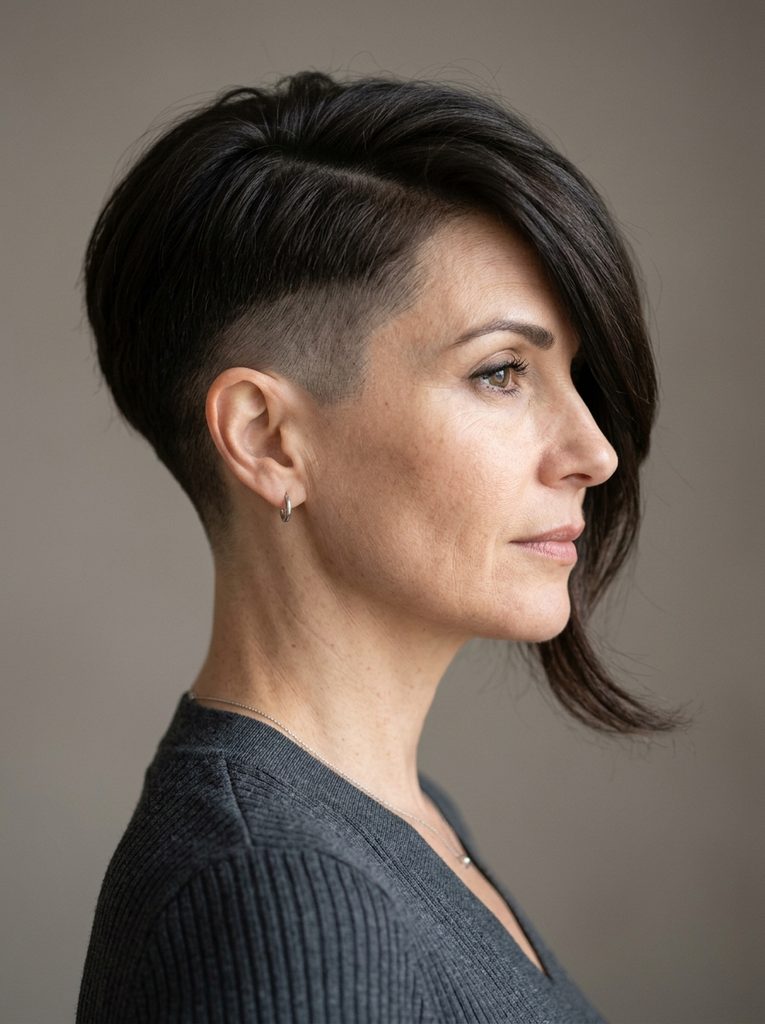
The classic sweeping fringe asymmetrical undercut pixie relies on an architectural silhouette that balances a closely clipped temple and nape with an elongated, cascading front drape. One side is cropped close to the scalp using a graduated clipper fade, exposing the ear and defining the cheekbone. The opposite side retains substantial length, featuring a dense, diagonal fringe that sweeps gracefully across the forehead from a deep side part. The crown is layered in fine increments to create natural root lift, which is particularly beneficial for mature hair that has lost internal density. This directional flow draws the eye diagonally across the facial plane, minimizing cheek width and softening forehead lines. The overall aesthetic is sleek, refined, and structured, providing an instant visual lift that highlights the natural beauty of women over 40.
Begin the haircut on damp hair by establishing a crisp, diagonal-back parting from the high recession point on the shallow side around to the opposite mastoid process. Clip the top canopy away securely. Use adjustable clippers with a number three guard to execute a graduated taper across the exposed temple and lower nape, blending smoothly down to a number two at the neckline. Release the top canopy, establishing a diagonal traveling guideline that ascends from the crown toward the longer front side. Elevate the crown sections to 90 degrees and point-cut deeply to build internal buoyancy. On dry hair, carve the sweeping fringe using slide-cutting shears, tapering from the eyebrow arch down to the opposite jawline. Blow-dry the fringe forward and across using a flat paddle brush, finishing with a drop of lightweight hair serum for a smooth, polished finish.