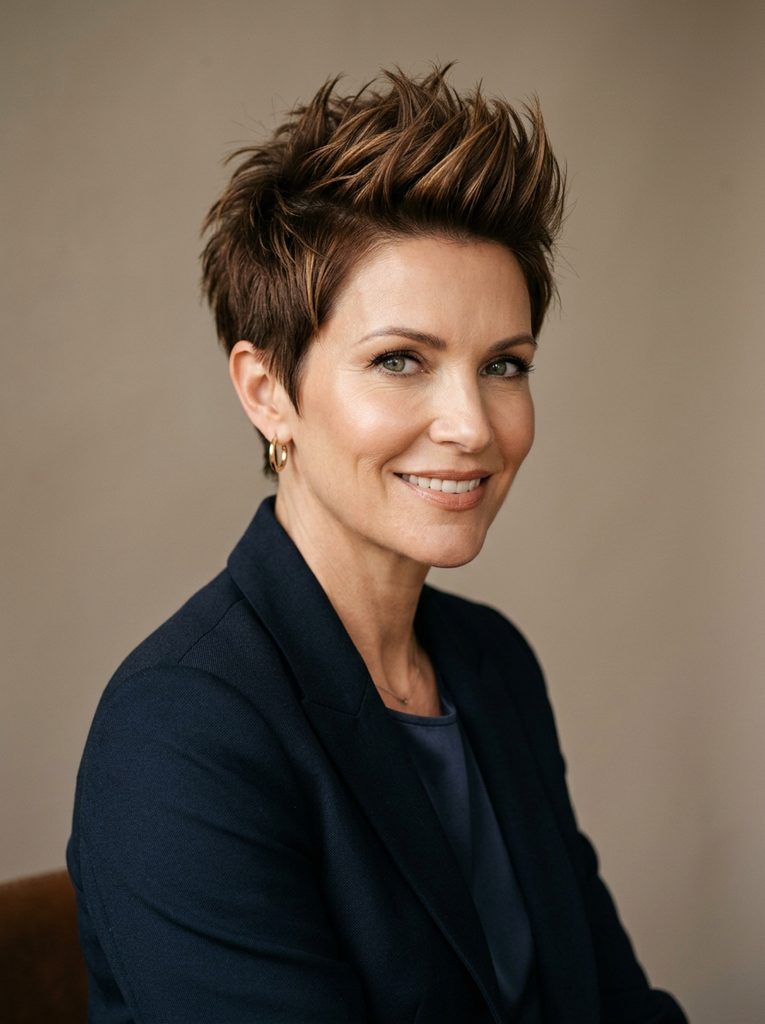
The edgy spiky pixie haircut represents one of the most empowering, dynamic, and visually striking short hairstyles for women over forty. As hair matures, hormonal fluctuations and chronological shifts often cause strands to lose natural density, elasticity, and root volume, making long or blunt styles appear limp and weighed down. Transitioning to an architectural, spiky pixie cut directly counteracts these textural shifts by removing heavy downward drag, concentrating structural volume at the crown, and accentuating facial bone structure. In this comprehensive haircut guide, readers will explore ten distinct variations of the edgy spiky pixie designed specifically to flatter mature facial profiles, enhance natural movement, and create the illusion of thicker, fuller hair. This tutorial details every technical phase of execution, from precision scissor-over-comb nape tapering and razor texturizing to directional blow-drying mechanics, root lift strategies, and lightweight matte product selection. Mastering these structural principles is useful for anyone seeking a low-maintenance, high-impact aesthetic that lifts the visual focus of the eyes, cheekbones, and jawline. By following these practical instructions, women over forty can achieve a versatile, youthful haircut that coordinates effortlessly with modern lifestyles.
Why This Idea Is Trending or Useful
The sustained demand for edgy spiky pixie haircuts across contemporary Pinterest ideas, salon lookbooks, and fashion feeds reflects a widespread appreciation for bold, age-positive hair design that celebrates personal confidence. For women over forty, this short haircut provides immense practical value because it eliminates weathered, split ends while distributing hair mass upward, preventing the flat crown common with longer styles. From a modern design perspective, the sharp, vertical textures and tapered edges act as an architectural frame, delivering an immediate lifting effect that sharpens the jawline and highlights the cheekbones without requiring complex daily routines. This style holds strong DIY and home styling appeal because its short length drastically shortens morning blow-drying schedules, simplifies wash routines, and eliminates dependence on heavy thermal curling irons. Beginners find the spiky pixie exceptionally accessible for salon consultation planning, as the clear distinction between short tapered sides and textured crown layers creates a defined benchmark for maintenance trims without ambiguous blending zones. The haircut serves as an empowering, low-maintenance creative project that delivers high aesthetic impact, timeless sophistication, and everyday practicality.
Materials and Preparation
Achieving and maintaining a professional-grade edgy spiky pixie cut on mature hair requires specialized cutting tools, proper physical setup, and lightweight nourishing hair care formulas. For precision cutting and maintenance trims, essential hardware includes sharp Japanese stainless steel shears, a guarded feathering razor blade, electric clippers with multiple attachment guards, durable duckbill sectioning clips, a fine-toothed cutting comb, and a wide-toothed detangling comb. The daily styling toolkit requires a ceramic tourmaline blow dryer with a directional concentrator nozzle, an ultra-fine water misting spray bottle, a flat vent brush, and a natural boar-bristle brush. The cosmetic product collection must focus on weightless volume, matte definition, and thermal defense: a botanical volumizing mousse, a texturizing sea-salt spray, a pliable matte styling paste or clay, a thermal heat protectant spray rated up to 450°F, and a gentle clarifying shampoo. Begin preparation by washing the hair with a residue-free hydrating shampoo, applying a lightweight moisture conditioner exclusively to the tips. Gently towel-blot moisture using a smooth microfiber towel, detangle thoroughly starting from the ends, and establish your natural parting line before starting sectioning.
1. The Classic Textured Crown Spiky Pixie
Step-by-Step Guide
The classic textured crown spiky pixie is the foundational benchmark for modern short haircuts, pairing a clean, closely tapered nape with two to three inches of point-cut layers across the crown. For women over forty, this architectural crop is remarkably rejuvenating because keeping the perimeter cropped close to the neck and ears removes downward weight, forcing the top layers to stand upright with natural lift. The crown layers are point-cut vertically to create textured peaks that reflect light unevenly, making fine or thinning hair appear significantly denser. The front fringe can be worn lightly swept or styled upward into piecey spikes that elongate the forehead and draw visual attention to the eyes. This minimalist design works exceptionally well on straight, wavy, and fine hair textures, delivering an understated, polished look that transitions smoothly between professional office settings and casual weekends.
+-------------------------------------------------------------+
|              [Classic Textured Crown Pixie]                 |
|                                                             |
|                      /\     /\                              |
|                     /  \   /  \    <-- Spiky Crown Peaks    |
|                    /    \ /    \       (Vertical Point-Cut) |
|                   . - ~ ~ ~ - .                             |
|               . '     . - .     ' .                         |
|             /       /       \       \                       |
|            |   ( Tapered Sides )     | <-- Scissor-Over-    |
|            |   ( Close to Ear  )     |     Comb Taper       |
|            |       |         |       |                      |
|   +================ Clean Tapered Nape ===================+ |
|   |  Close-Cropped Baseline Hugging the Natural Hairline  | |
|   +=======================================================+ |
|                                                             |
|  ==================== Structural Matrix ==================  |
|  [ Crown Elevation Balances Tapered Perimeter Density     ]  |
+-------------------------------------------------------------+
Begin by sectioning the top horseshoe crown area away from the back and sides using duckbill clips. Working at the nape, use the scissor-over-comb technique to establish a clean, graduated taper that hugs the natural curve of the neck, blending upward toward the occipital bone. Move to the sides, tapering the hair neatly around the ears and leaving soft, wispy sideburns. Release the top horseshoe section, lift vertical subsections straight up at a ninety-degree angle from the scalp, and use deep vertical point-cutting to establish two to three inches of textured length across the top. Apply a dime-sized amount of volumizing mousse to damp roots, rough-dry the hair with a blow dryer while lifting the crown strands upward with your fingers, and finish by warming a pea-sized amount of matte styling clay between your palms, pinching the top layers into defined, vertical spikes.